Enjoy these photos of the students with their plants! Students were amazed at how many roots and leaves grew over the last two and a half weeks. Watch for a display of their wonderful observational drawings!
Wednesday, October 9, 2013
Tuesday, October 8, 2013
Indian Hats?!
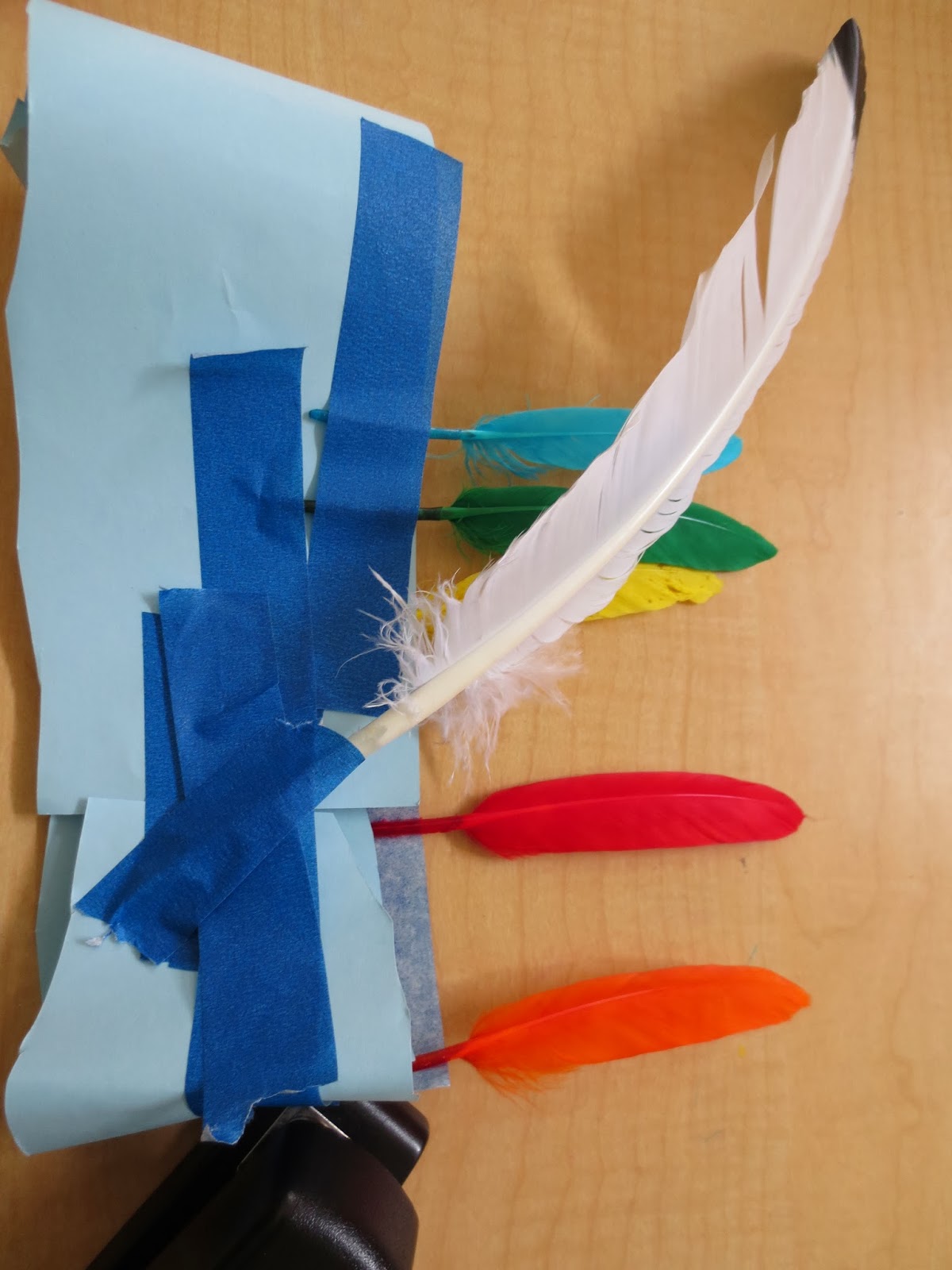
Over the past few days, some of the children have been asking for feathers from our art center to make "Indian Hats".
This presents an interesting opportunity to further our diversity work. This work is often a bit unclear and, at times, uncomfortable. The children feel no discomfort. After all, they are just making "Indian Hats". To them, this is a simply a fun and creative craft activity. So why does this activity bring up discomfort for some adults? Is it because the Native Americans have been victims of genocide and still face serious struggles to this day? Is it because they are depicted negatively in children's movies and in the media in general? Perhaps these questions lead us to feel protective of the Native Americans, and we impulsively rush to defend their name and their image - even from children who are innocently engaged in a craft activity. So at this point you may be wondering how we are handling the situation. Is there even a "situation" that needs handling? Here is a dialogue that occurred between teachers...
Raji: "Some of the children are making "Indian Hats". It seems harmless enough, but for some reason I feel like I should say something to them about it. What's your take on this?"
Kathy: "You could try asking them what they know about Native Americans..."
Raji: "Great idea! I'll do that."
So here is what they know about Native Americans...
They have bows and shields
They wear these hats all the time
They fight with bows and arrows
I started telling them about how there was a guy who thought he was in India, but he was wrong - so he started calling them Indians. Now we refer to them as Native Americans (although you might meet some who prefer to be called Indians - respectful terminology is often a moving target). I also told them that the hats with feathers were usually worn during "holidays", and not all the time, as some may think.
I stopped there, because I am not an expert in the field, and kindergartners have a relatively narrower range of attention than most grown ups.
I started thinking about our seed study and I planned on making some kind of a connection there...
Hey - wait a minute... The 4th graders are studying the Lenape - the Indigenous people of this region! We look forward to their visit tomorrow as they share some interesting information that they have acquired in their individual research on topics that they have chosen to study...
Friday, October 4, 2013
Catching up!
¡Hola!
Dear Parents, Raji and I had not realized until recently that I did not had access to the childrens' blog. So below is a brief summary of the activities in the classroom:
- Using puppets Alejandro (a blue dog) to teach the children greetings such as buenos días or mucho gusto. They have also learned that sometimes when you greet, you give a kiss in the cheek to one another. Hence, the kinds learned to say "un besito" (a small kiss).
- We have traveled with Alejandro to different countries in Latin America and learned the names of mediums of transportations: avión, tren, barco chiquito.
- We have sang a few songs such as El Chocolate and El Barco Chiquito. But their hearts and minds is set on a dance/song called "Conga, Conga". If you ask them, they will be able to show it to you!
- This week we reviewed numbers from 1 to 10 and today we introduced them to numbers from 11 - 20 with bingo.
- In each class we try to open with some physical exercise, breathing, and a minute of silence. Then we close with un abrazo en grupo (group hug) or some other greeting.
NOTE: As soon as I resolve some technical difficulties, I will post some photos and videos.
| Dancing their favorite song! |
| Playing with dices to learn numbers |
| El minuto de silencio (The minute of silence) |
Friday Highlights
Sprouting seeds in Science class and observational drawings...
Book Fair - Guest Author Lee Harper reads his books to our Kindergartners!
Bingo in Spanish class with Eliasa
What a fun-filled and exciting week of Kindergarten!!! Have a fantastic weekend everybody - Be sure to spend LOTS of time outside in the amazing fall weather!!
Winning, Losing and Math
We recently had the children sign in with a question.
"What Kind of Ice Cream Do you Like Better? Vanilla or Chocolate?"
Later in the day, we looked at the names on the paper and we gathered around a graph with the numbers 1-10 across the bottom and the words "Vanilla" and Chocolate" on the sides.
We then transferred the data from the sign in sheet to the graph by giving the children a brown or white square to place on the graph.
As we were in the process of figuring out which flavor was winning, there were some hurt feelings on the side of the losing flavor. What an excellent opportunity to discuss competition!!
We explained that games are fun. When you are playing them, you are excited, and many people who play games are very interested in winning them. If you are playing a game and having fun, why is it so bad if you lose? We discovered that if you win, it was fun while you were playing. Also, even when you lose, it was still fun when you were playing. So, what you do to remember that it was fun, is this...Wether you win or lose, you say to the others who played, "Good game." It turns out that it is okay to win games, and it is okay to lose games. You don't have to like losing games, but it is important to be nice. So if you win, say, "Good game." If you lose, say, "Good game", and remember that you had fun playing.
(Congress needs to go back to Kindergarten:-)
We look forward to exploring more graphs in the near future...
Wednesday, October 2, 2013
Music
Kindergarten has been listening, exploring, reading, singing
and dancing in music class!
We have been reading ‘The Tiny Seed’ by Eric Carle and have begun
to tell the story with our bodies.
Music - Spiegel im Spiegel by Arvo Part (Winter - Spring)
| It is SPRING!! |
| the rain falls on the seeds, |
| the seeds begin to wake up... |
| ... and start to grow! |
| It is SUMMER!! What will happen next?! |
Here
is a link to concerts aimed to introduce young children to the orchestra:
Tuesday, October 1, 2013
Seeds!
There is a growing, blossoming, sprouting interest in seeds! Many children are bringing seeds in from home - even the teachers are doing it! We have seen some very interesting and colorful seeds over the past few days. We are all in awe of the fact that a tiny seed can become a giant tree!!!! There is a seed sprouting activity well underway in science class. There are songs about seeds in music class. It would appear that we are now officially in the thick of an emergent unit on seeds! Here are some preliminary questions about seeds from our budding investigators...
Samara
– Where are the seeds in the pinecones?
- Why
do little seeds turn into big trees?
Shelby
– Why are seeds so black?
Arrianna
– What happens when you plant seeds?
Trese –
How do seeds grow?
Matthew
– How do seeds change color?
Alexander
- What seeds can you eat?
Jacob – How do you find the seeds in pinecones?
Grace
– Why do plants have seeds?
Amir
– What are all the different things you can do with seeds?
Hannah
– Why do some seeds have spikes?
Now that we have some questions to ponder, we will begin to figure out how to answer them.
If you or anyone you know happens to have some expertise in seed lore, please let us know!
Subscribe to:
Posts (Atom)