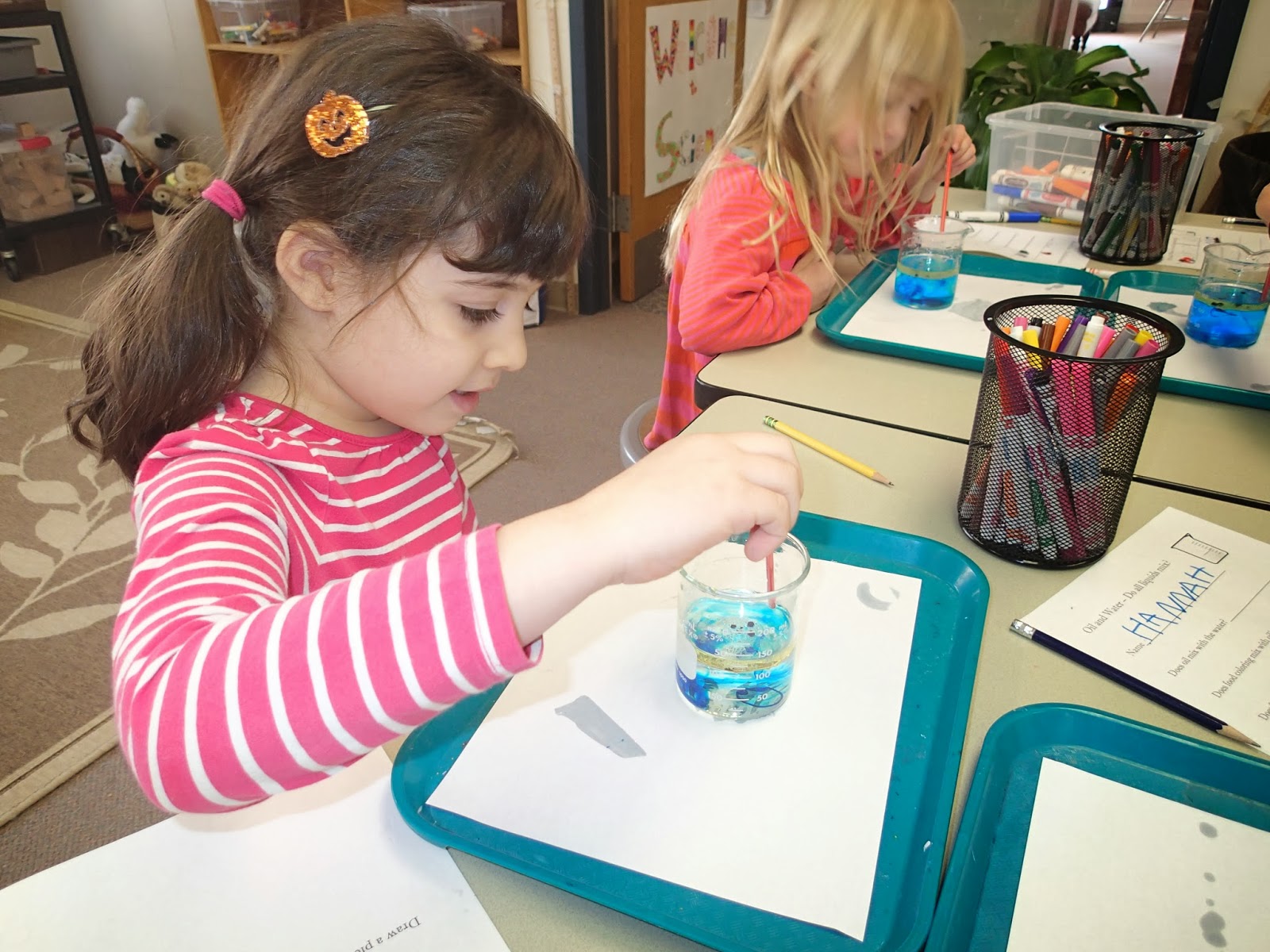
In Kindergarten chemistry, we experimented with liquids and mixing. Do oil and water mix? That was our first question that we asked. The students were so surprised when the oil stayed on top of the water no matter how much they tried to mix it! What came next was even more startling. Next we added drops of food coloring. The food coloring did not mix with the oil and in fact, became dozens of tiny, colorful drops suspended in the oil. When a drop fell through the oil to the water, it definitely mixed with the water! The students then did beautiful observational drawings of this experiment.
Wednesday, January 29, 2014
Monday, January 27, 2014
Inspired by Dr. King
We read about the amazing work of Martin Luther King, and we sang the song, "What Can One Little Person Do" during a Lower School Assembly. Then each child wrote to the prompt, "I have a dream that..." We decided it would be fun to share our ideas about how to make the world a better place. Soon we were so excited to write a play that we could perform in front of all the kindergarten families and the whole Lower School! As it turns out we have a talented playwright in our community. Hannah's father, Michael Elkin, came in to school today to help us figure out how to proceed with our ideas. We came up with a very interesting mix of characters that will be played by the children (I won't spill the beans yet...)
Stay tuned!
Stay tuned!
Tuesday, January 21, 2014
Tuesday, January 14, 2014
Reactions Experiment!
Today Kindergarten students tried another chemistry experiment: "Reactions and Jumping Raisins". It was pretty exciting to see what can happen when you combine certain substances like vinegar and baking soda. The reaction between baking soda (sodium bicarbonate) and vinegar (dilute acetic acid) generates carbon dioxide gas which produced the "explosion" that happened in our first experiment.
Next, we added the raisins. What would happen? As we observed the raisins, we noticed that they initially sank to the bottom of the glass. Next, they "magically" rose to the top of the beaker, and then sank again. They were jumping up and down! What was happening? The raisins sank to the bottom of the beaker due to their density, but because raisins have a rough, dented surface, they are filled with air pockets. These air pockets attracted the carbon dioxide gas in the liquid, creating the little bubbles on the surface of the raisins.
The carbon dioxide bubbles increased the volume of each raisin. With a greater volume, the raisin displaces more fluid, which then applies more buoyant force, pushing the raisins upwards. At the surface, the carbon dioxide bubbles pop and the raisins’ density changes again. Then they sink back down to the bottom. The whole process is repeated, making it look as though the raisins are dancing or jumping!
Next, we added the raisins. What would happen? As we observed the raisins, we noticed that they initially sank to the bottom of the glass. Next, they "magically" rose to the top of the beaker, and then sank again. They were jumping up and down! What was happening? The raisins sank to the bottom of the beaker due to their density, but because raisins have a rough, dented surface, they are filled with air pockets. These air pockets attracted the carbon dioxide gas in the liquid, creating the little bubbles on the surface of the raisins.
The carbon dioxide bubbles increased the volume of each raisin. With a greater volume, the raisin displaces more fluid, which then applies more buoyant force, pushing the raisins upwards. At the surface, the carbon dioxide bubbles pop and the raisins’ density changes again. Then they sink back down to the bottom. The whole process is repeated, making it look as though the raisins are dancing or jumping!
Monday, January 13, 2014
Further Investigations Into Symmetry
During Choice Time some of the children decided to make symmetrical designs with our pattern blocks. After Gym class, we explored more design possibilities using colored squares. Each child began creating a symmetrical mosaic design. To accomplish this task, they needed to understand the concept of the midline that divides a symmetrical object into its mirror images. Here is an example of the reasoning involved - "If I put a red square 2 spaces from the midline on the left side, then I have to put a red square 2 spaces from the midline on the right, opposite the other red square."
Thursday, January 9, 2014
Best Day Ever!
This was the chant heard from many kindergartners on Wednesday. The children were quite excited by the days' activities. Here are a few highlights. We started the day with Choice Time during which they developed their fine and gross motor skills along with interpersonal and conflict resolution skills. Then we enjoyed Meeting For Worship in our lovely Music Room with the other kindergarten and the 4 Early Childhood classes. During this time they developed their reflective capabilities and strengthened their impulse control. Then we had Morning Meeting and Snack. This was followed by Library and Writer's Workshop. They were overjoyed to have their first experience of the year using laptops in Library. During Writer's Workshop, we shared our journal entries, talked about leaving spaces between words, and we reinforced sight word recognition by referencing our word wall. We also practiced a new decoding technique called tapping. For a word like "cat", you would tap your thumb to your pointer finger and say the hard "c" sound. Then you tap your thumb to your middle finger and say the short "a" sound. Then you tap your thumb to your ring finger and say the sound for "t". Lastly, you slide your thumb across all three fingers from pointer to ring and say the sounds blended together. Ask your child to show you how it works! We also got to make letters and numbers with our fingers on a tabletop covered in shaving cream!! After writer's workshop we had a discussion about symmetry, and we practice d making our bodies symmetrical and asymmetrical. Now we are making symmetrical patterns with pattern blocks, and soon we will make color tile designs applying the concept of symmetry. It is inspiring how the children approach these concepts with such joy and excitement. May we learn well from the positive attitudes of our young friends!
Tuesday, January 7, 2014
The Science of Polymers
Right before break, the Kindergarten students learned about the chemistry of polymers. They took hydrophylic, or water loving, plastic alligators and placed them in water for a week. At the start of the experiment they were about 11 cm long. I posed a question to them; "What do you think will happen to the alligators in the water?" There were many hypotheses, such as "They will melt!", "I think they will change color." After a week in the water, the students were very surprised to see that the alligators absorbed the water and became huge! Some were as big as 35 centimeters! We also grew "water jelly crystals" that even changed color since we added food coloring.
Subscribe to:
Posts (Atom)